
Cancer seems to be the ultimate scourge of medicine. It ruthlessly and indiscriminately kills, and shows no significant decline even after humanity sends an army of researchers and doctors to combat it. Sometimes, we are fortuitous to find clues that lead us to closer to a cure for cancer, the holy grail of medicinal academia, but these ventures are reported once in the news and never heard of again, succumbing to the scrutiny of the FDA and the struggle of passing through clinical trials. Even though there are many treatments for cancer out there such as different combinations of chemotherapy, the fight with cancer is almost always an uphill one. Yet, the constant emergence of new and promising technologies brings hope to the desolate battlefield.
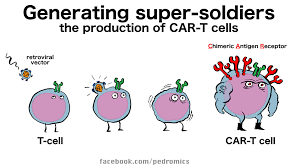
One such technology is chimeric antigen receptor t-cell therapy (CAR T-cell therapy), which has been shown to be effective at treating certain leukemias and is being investigated for use in solid tumors. The technology uses cytotoxic T-cells that have been genetically modified to express a chimeric antigen receptor that specifically targets tumor cells. Upon binding to the tumor cell, the CAR T-cell initiates apoptosis in the malignant cell, destroying it. However, according to a recent review published in Cancers, solid tumors are varied in their location and composition and complex in their defensive mechanisms, making the CAR T-cell effort more difficult. There is also the risk of side effects such as toxicity from the cytokines released by these genetically foreign cells. Although the technology seems promising, there appears to be a lot to be done before it can be generalized and personalized for all cancers.
The true efficacy of CAR T-cell therapy is still being investigated, but it is clear that one large issue at hand is the accessibility of this life-saving procedure. Even though only one infusion is needed to exhibit noticeable outcomes in the patient, this single dose can cost upwards of $373,000. This has brought up debate as to whether a therapy that could buy a large house but isn’t guaranteed to cure is worth the money over other more tried and true (though equally dubious in success rate) methods. Perhaps as research find better ways to manufacture and administer these medications, prices will drastically decrease. Yet its unknown how long that could take, and another technology could easily arise within that time and render CAR T-cells obsolete. Nevertheless, the strong academic force pushing for the success of cancer therapy is encouraging, and one worth talking about periodically, perhaps over tea.

 Is Cereal a Soup